Showing posts with label Gazes. Show all posts

13.8.12

remembering folk


Characters and caricatures; the idealized heads of St. John and St. Paul are contrasted with grotesque heads, above them rises a cloud of faces showing different expressions. Etching by W. Hogarth, 1743 © Wellcome Library, London

The funeral procession of the Dutch naval commander de Ruyter in 1677 © Wellcome Library, London

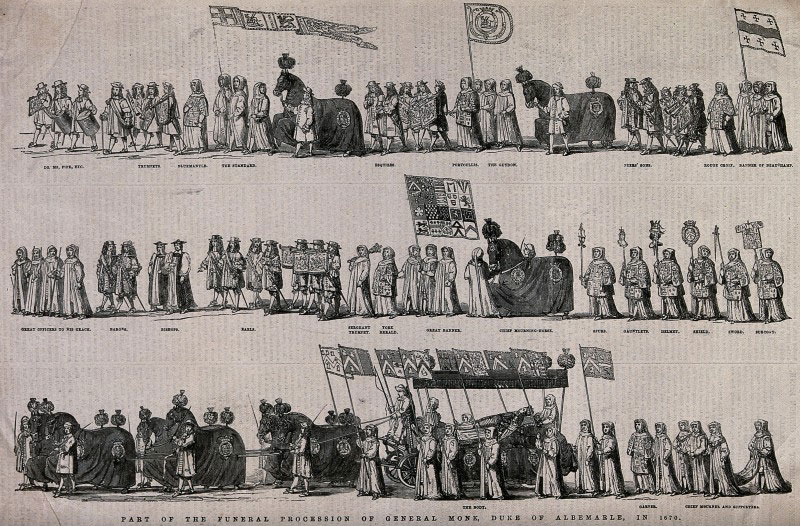
Part of the funeral procession of General Monk, Duke of Albemarle, in 1670. Wood engraving.
1852© Wellcome Library, London

Funeral procession of a queen passing through Hammersmith in London. Etching with engraving by C. Canton after R. Banks © Wellcome Library, London

The two top photographs were taken of framed 'photo-collages' - for want of a better word - at Fiskars Museum. I've not really seen anything quite like it in the UK before. Perhaps it is a peculiarly Finnish way to document people linked by blood, institution, geography or politics? They reminded me of images that I've been collecting of visual lists for some time now, including this one by Hogarth and three funeral procession prints (all from the Wellcome Trust).

7.12.10

note # 1

Two things to note about cats:
1. Have you ever felt your cat's purr? You know they really love you, when they trust you enough to let you put your hand on the vulnerable spot at their throat, where you can feel their purr rattle and dance.
2. When I smile at my cat, she turns her ears to face me: like she can hear my smile. It makes her look like an owl. I like the idea that a smile is more than just a visible thing, that it might have a sound too.

18.3.10

dark chamber

 Camera obscura, c. 1769, anonymous etching

I'm thinking back to those ten missing days. I want to make project about it. It may start here. Enough said.

11.2.10

misty-eyed


I found this chair several years ago at the tip and bought it for a fiver. It needed a lot of sorting out but it was already clear that it was a gem. When I took the rotten padded seat out of it I discovered amongst the horse-hair stuffing a cheap fake-gold necklace. Odd that it was tucked away in there when it clearly wasn't valuable, and there's no way it just drifted there by accident: it was absolutely placed with intent.

After some investigation I found out that it was an old sea captain's chair - it rolls back on it's axis (rather squeakily) and would have been used in a ship's bridge.

This weekend when I removed the sheepskin on it to give it a dust, I discovered that it was covered in salt. The marks all over it looked like the trails of tears. Very mysterious. I've oiled it now, so we'll see what happens next.

31.1.09

no ears to prick up, no mouth to utter

No ears to prick up, no mouth to utter

Designs for bird balaclavas, preventing the wearer from both hearing and speaking properly.

24.1.09

black light

Claude Glass. Photo: V & A

The gloomy Claude glass is a convex blackened mirror designed in the 18th century to aid artists and tourists to create landscape paintings. They would turn their back away from the landscape and instead view it in the mirror, which would present a vast scene in a more manageable size whilst also subtly harmonising the tonal values of the view.

Claude Lorrain (1600-82) was a leading 17th-century landscape painter who worked in Rome and became famous for drawings and paintings displaying a subtle gradation of tones. His work became immensely popular in England in the 18th century. The Reverend William Gilpin, an amateur artist, advocated the use of a Claude glass saying, 'they give the object of nature a soft, mellow tinge like the colouring of that Master'.


16.1.09

19.6.08

pause under glass vol. V


Notes on slumbering under a glass shade:

.
.
.
Static.
Preserved in aspic.
Hiatus.
Respite.
Holding breath.
Pause.
.
.

All that is precious, encased. Glass domes denote value, consequence, substance.
.
.
.
.
Recognition of the passage of time is avoided, by preventing dust from landing on the object contained within glass.
.
.
.

Wardian case: protected glass houses for ferns.
.
.
Tableau vivant: silent, motionless group of people, to be admired.
(Kate Matthews Collection.)
.
.
.
.
.
Statues
.
.
.
.
.
.
.

23.4.08

Somewhere-Nowhere

‘I see the next-door house from a certain angle, but it would be seen differently from the right bank of the Seine, or from the inside, or again from an aeroplane: the house is none of these appearances… But what do these words mean? Is not to see always to see from somewhere? To say that the house itself is seen from nowhere is surely to say that it is invisible? … The house itself is not the house seen from nowhere, but the house seen from everywhere. The completed object is translucent, being shot through from all sides by an infinite number of present scrutinies which intersect in its depths leaving nothing hidden.’

Maurice Merleau-Ponty, The Phenomenology of Perception, 1962

Backward Glance

'The term orphism* comes from the mythic persona of Orpheus, son of Oeagreus, king of Thrace, and Calliope, a muse. The god Apollo gave him a lyre and the Muses taught him how to use it. With his lyre, Orpheus seduced and charmed ferocious beasts, trees and rocks. After a stay in Egypt, he came back to marry Eurydices. One day, Eurydices met Arsitée, who tried to rape her. When she tried to escape she stepped on a snake which killed her. Orpheus tried to bring her back to life by going to the Tartare, the underworld. There he seduced Cerberus, the three Judges of the Dead and Hades himself, who gave Orpheus the permission to bring back Eurydices to the upper world. The only thing that Hades asked of Orpheus was that he did not look back at Eurydices to see if she was following him back to life. Having looked at her, she dies, and Orpheus returns alone to the upper world where he becomes a recluse in the forest.'

www.ditl.info


_ _ _ _ _
_ _ _ _ _ _ _ _ _ _ _ _ _ _ _ _ _ _ _ _ _ _ _ _ _ _ _ _ _ _ _ _ _ _ _ _ _ _ _ _ _ _ _ _ _ _

* Orphism |ˈôrˌfizəm|
noun

1 a mystic religion of ancient Greece, originating in the 6th or 7th century BC and based on poems (now lost) attributed to Orpheus, emphasizing the necessity for individuals to rid themselves of the evil part of their nature by ritual and moral purification throughout a series of reincarnations.

2 a short-lived art movement ( c. 1912) within cubism, pioneered by a group of French painters (including Robert Delaunay, Sonia Delaunay-Terk, and Fernand Léger) and emphasizing the lyrical use of color rather than the austere intellectual cubism of Picasso, Braque, and Gris.

20.4.08

Studies in Indirect Communication vol. III

Source: The Encyclopedia of Ephemera, Maurice Rickards, 2000


The deeds on my house state that as it is classed as a residence, it is illegal to run a business from within my own four walls. In the past, people got round this problem of letting the 'right' people know that they were working from home by discretely placing small 'adverts' within their windows. Small and decorative enough to be difficult to read unless you were in close proximity, they were also explicit in their communication once you made the commitment and ventured nearer…

18.4.08

Domino Visor or Impassive or Studies in Indirect Communication vol. I

Illustrated Catalogue of Papier Mâché, Linen, Wax, Wire, Gauze, Show and Curtain Masks, Noses, Wigs, Beards, Etc.; Findlay; The American Mask Manufacturing Company; 1915.

13.4.08

The back of the plan-chest


One thousand-thousand notebook gazes, 2000 - 2002


10.4.08

The Mexico Chapters: Laundry list


Sulky clouds // Dehydrated oranges left hanging beyond the wall // Deluge // Car stalls on barely-lit cobbled streets // Contemplate one thousand plastic rams in a bag // A collection of non-buckets // Hot-chocolate with almonds, honey and cinnamon - the best hot chocolate I've ever had made for me.

'MC: This work has a very long title: "Flying Saucer: Rainbow/Two Cyclists/Dog/Gorilla and Bananas/Chaotic Situation/Couple/Tortoise/Gunman (Fallen)", 1992.

JB: I just wanted to get everything in there.


MC: Like a laundry list.

[…]

JB: I've explained them as being how we experience the world. If you walk into a room and you have a lot of trash in your hand you're going to see the trash can and probably not see very much else or if you do, you might see a colour some place or whatever and everything else might be avoided. The next day you might be hungry you might see the potatoes and everything that's not of interest will be avoided. So they're really lessons in seeing what's important. What things do we see first? Do we focus on what's of use or, for visual delight. What things are we not interested in?'

Randomly found the other day, in an old sketchbook from the RCA, in the days before I religiously referenced everything that I pilfered. Think this is John Baldessari talking about creating paintings from photographs.

Love lists.

7.4.08

Knit-head

Photo: Jeremy Horner


These are brilliant. But despite laboriously trying to find hard facts, they still remain somewhat illusive.

The top picture was scanned from a 2004 edition of
Death in the Andes (Mario Vargas Llosa), published by Faber & Faber. This was where my curiosity was piqued.The bottom picture came from this site where I picked up some scant information about the origins of these knitted masks.

There are versions of these woollen masks in the neighbouring countries of Bolivia and Peru. In Bolivia they are said to be used by the Qollas of Puno and Paucartambo (other types of cloth mask are worn by the Qusillu of the Altiplano). The masks are hand knitted to depict human features, including curling moustaches, beauty spots, chins and rosy cheeks. It's somehow fitting that the Qollas people use knitting to create these pieces as they are traditionally llama herders who roam the mountains, to which wool and knitting are closely associated.

If you're interested in more information about the rituals in which these masks are used, look at this book review: Shaping Society Through Dance: Mestizo Performance in the Peruvian Andes by Zoila S. Mendoza.

* * *

Nice that when you put on a mask, you reinvent yourself.

But your eyes, your view of the world, stays the same. It's the part that the mask can't cover/alter/enhance. Or at least, it shouldn't, if the mask is to remain practical. I think.

So although you look like someone/something else to those around you, you haven't actually altered your perspective. But I guess the knowledge that your true self is hidden, is enough for some to create an alter ego far beyond the limits of the corporeal.

Maybe a bit like me, when I change my glasses. Or my boots. Never tried masks. Because of the glasses. Must address that.

4.4.08

Jerome

'One day, quite some time ago, I happened on a photograph of Napoleon's youngest brother, Jerome, taken in 1852. And I realized then, with an amazement I have not been able to lessen since: "I am looking at eyes that looked at the Emperor." Sometimes I would mention this amazement, but since no one seemed to share it, nor even to understand it (life consists of these little touches of solitude), I forgot about it.'

Camera Lucida
, Roland Barthes, Vintage, 1993.