Showing posts with label Absences Negatives Versos. Show all posts
26.9.15
bideford black: printed shadows
And finally… all the tones: accumulated, layered, overprinted, repeated, cut up, collaged. All printed in my Bideford Black letterpress ink. These are one part of my larger work and will, in one variation or another, be appearing at the Bideford Black: The Next Generation show, starting at the Burton Art Gallery & Museum on October 3rd.
2.9.15
26.8.15
bideford black: trailer
The trailer for Bideford Black: The Next Generation is out!
The full-length feature film will be ready for the exhibition which starts October 3rd at Burton Art Gallery & Museum, Bideford.
Thank you Liberty Smith for all your hard work getting this together.
3.7.15
15.6.15
bideford black: dot dot dash, drawing, drawing, drawing
![]() |
| Tones and drawing on studio wall |
![]() |
| Drawing Bideford-inspired tones |
![]() |
| Drawing Bideford-inspired tones |
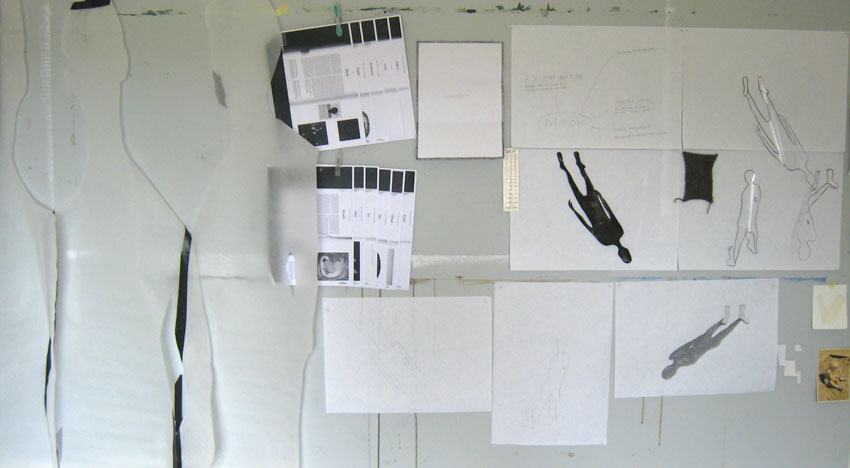
Out with the pencil and drawing tones, inspired by samples of shadows, blacks, glooms and darknesses gathered whilst snooping round the archives at the Burton Art Gallery & Museum. It's amazing the array of techniques that artists have developed through paint, print and pencil to show shadow and form.
22.2.15
bideford black: making an ink to print on a press
![]() |
| Grinding Bideford Black |
![]() |
| Mixing a Bideford Black letterpress ink |
![]() |
| A jar of Bideford Black letterpress ink |
Weeks and weeks of grinding and mixing, regrinding and testing to get an ink made of Bideford Black that dries quickly, doesn't smudge or transfer, sits well on paper and hopefully is relatively light-fast… Time will tell.
30.1.15
15.1.15
bideford black: of ink and tones
![]() |
| Tones gathered at Bideford Archive © Lizzie Ridout |
![]() |
| Tones gathered at Burton Art Gallery & Museum © Lizzie Ridout |
Start at the beginning…
Reading up on the wider cultural significance of black and particularly interested in black as ink. That's to say, the qualities of ink and how it's been used in history. Also as the sort of supporting hero in the bigger and hugely important story of the invention of the printing press.
First stop, Bideford Archive to gather examples of blacks used as tones from old, local newspapers, followed by a similar process at the Burton Art Gallery & Museum, Bideford.
15.12.14
black list
Black is night skies, gloom, shadows, caves and dungeons; blackboards, witchcraft, chimneys, a punch-to-the-eye. It is negativity, formality, convention, sophistication and seduction. It is the printing press, pigment and photocopiers. It is earth, oil and dirt; life, death, mourning and melancholy. It is blackout curtains, a Claude glass and a camera obscura. It is darkness, the absence of light, all colours and yet no colours. It is a void, a deletion, a censorship, a secret, a mystery. It is the end. And it is the beginning.
29.8.13
thinking radio
Listening to the Open Air series of sound pieces on Radio 4, commissioned by Artangel's Open project and broadcast earlier this year.
At just 3 minutes long, I particularly enjoyed Christian Marclay and Ruth Ewan's pieces which reminded me of this previous post, about Murke's Collected Silences by Heinrich Böll, from this time last year.
And timely, when I'm reading this article Outloud by Steven Connor too.
At just 3 minutes long, I particularly enjoyed Christian Marclay and Ruth Ewan's pieces which reminded me of this previous post, about Murke's Collected Silences by Heinrich Böll, from this time last year.
And timely, when I'm reading this article Outloud by Steven Connor too.
28.8.12
wool foot vol. iii
![]() |
| Image 2 © Victoria and Albert Museum, London |
![]() |
| Image 3 © Victoria and Albert Museum, London |
![]() |
| Image 4 © Victoria and Albert Museum, London |
![]() |
| Image 5 © Victoria and Albert Museum, London |
![]() |
| Image 6 © Victoria and Albert Museum, London |
![]() |
| Image 7 © Victoria and Albert Museum, London |
![]() |
| Image 8 © Victoria and Albert Museum, London |
We were at a small village market the other day and there were hand-made socks on sale on one stall for 5 Euros. My friends were balking at the price, but I feel I have to lead the defensive on this - do you have any idea how long these things take to knit? And you have to make two of them…
While rummaging around on the V&A Search the Images I stumbled across these beautiful images of socks and stockings from across the centuries. Once you start to learn just how to make these things, you start to appreciate them as small but wonderous (and somewhat unappreciated?) works of art.
Images 1 and 2 have bible mottos woven into the upper part of the stocking. These were both most likely produced for the Great Exhibition to show the high quality that manufacturers' machines were capable of.
Image 3, 4, 5 show socks produced in Egypt in 250-420 AD, 410-540 AD and 200-499 AD respectively. They all use the single needle method of knitting which was much more time consuming than knitting with two needles and more like a form of sewing to knitting with two needles. The double-toed design meant that they could be worn with sandals, although the patching shows that wear and tear was common, though the socks were repeatedly mended.
Image 6 has little information but was knitted in England in 1838.
Image 7 shows a pair of women's stockings made of knitted silk, in Spain, during the mid 18th century.
Image 8 shows a pair of hand-knitted men's stockings in coloured wools, produced in Kashmir in the 19th century.
27.8.12
in the basement
The wonderful Erja Huovilan at Paperitalo here in Fiskars loned me kit and paper to ramp up the press in the basement this weekend. It was good to just change the pace, work with inky stuff and try to play for a while. All the above very childish and crude really, and not neceessarily a means to any particular end. But the exercise has made me stop to think a little bit more about the nature of the shadows. Particularly the knitted one I'm making. It's so very static. I like this - but in the above prints the ones I think captured the qualities of a shadow the best are exactly the opposite: the ones that shift and waver, the ones that are more enigmatic. And of course, all the most interesting things in print are not the pieces you try your hardest on, but the ones that on the throwaway newsprint behind the print intself… Always the way.
25.8.12
it grows vol. iv
Now, onward with the much larger shadow. And the writing…
24.8.12
swing time
Just watching Werner Herzog's Cave of Forgotten Dreams and came across this incredible Fred Astaire Bojangles of Harlem dance sequence from Swing Time (1936). Start from 5:00 minutes in for the part I'm talking about…
23.8.12
pinned
22.8.12
glass domes
Time - and dust - stops under a glass shade…
Still gathering things for the Black edition of The Paper Museum. Not sure this exactly fits, but the idea of a visual pause seems synonymous to me with blackness, darkness, shade.
21.8.12
it grows vol. i
So imagine you are looking at the top of a sock…
The left image is as if you were looking at the sock from its toe towards the heel, the right image is looking from the heel towards the toe…
You will note that I have managed to knit in a round…
And how to shape what is the beginning of the heel…
Onward.
I actually feel like I'm learning something.
a collection of things that may well be called absences
![]() |
| 1 |
![]() |
| 2 |
![]() |
| 3 |
![]() |
| 4 |
![]() | ||
| 5 |
I'm still gathering things that might be called absences to potentially go in the Black edition of The Paper Museum…
1. A black-out lantern: Photograph taken in Fiskars Museum of what was once a regular lantern, but which, during the war, was blacked over to hide the light during night-time raids.
2. Shadow of a plane: This image of the shadow of a plane on a landscape, by Lois Darling for the Japanese translation of Rachel Carson's Silent Spring. Found at the Yale University Beinecke Rare Book & Manuscript Library.
3. Painted-in windows: I remember seeing a lot of these in Bath where I grew up, but I never knew why. And then SB told me about the peculiar window tax, which required occupants to pay property tax based on the number of windows in a house. Houses built during the period between 1696 and 1851 (when the tax was revoked) are often seen with bricked-in windows, ready to have glass put in at a later date.
4. Author as shadow: Photograph by Hugh M. Neighbour Snr. Found at the Yale University Beinecke Rare Book & Manuscript Library.
5. Scipod: The name derives from the Greek skiapodes or σκιαποδες meaning shadow feet. Also known as monopods, these mythical creatures had one leg with a large foot that they used to shade themselves from the sun with. Some illustrations also show the little dudes with two legs, one of which has a much bigger foot. More information here. Image found at the British Library.
Subscribe to:
Posts (Atom)


