Showing posts with label Displays. Show all posts
26.9.15
bideford black: printed shadows
And finally… all the tones: accumulated, layered, overprinted, repeated, cut up, collaged. All printed in my Bideford Black letterpress ink. These are one part of my larger work and will, in one variation or another, be appearing at the Bideford Black: The Next Generation show, starting at the Burton Art Gallery & Museum on October 3rd.
26.8.15
bideford black: trailer
The trailer for Bideford Black: The Next Generation is out!
The full-length feature film will be ready for the exhibition which starts October 3rd at Burton Art Gallery & Museum, Bideford.
Thank you Liberty Smith for all your hard work getting this together.
3.7.15
15.6.15
bideford black: dot dot dash, drawing, drawing, drawing
![]() |
| Tones and drawing on studio wall |
![]() |
| Drawing Bideford-inspired tones |
![]() |
| Drawing Bideford-inspired tones |
Out with the pencil and drawing tones, inspired by samples of shadows, blacks, glooms and darknesses gathered whilst snooping round the archives at the Burton Art Gallery & Museum. It's amazing the array of techniques that artists have developed through paint, print and pencil to show shadow and form.
22.2.15
bideford black: making an ink to print on a press
![]() |
| Grinding Bideford Black |
![]() |
| Mixing a Bideford Black letterpress ink |
![]() |
| A jar of Bideford Black letterpress ink |
Weeks and weeks of grinding and mixing, regrinding and testing to get an ink made of Bideford Black that dries quickly, doesn't smudge or transfer, sits well on paper and hopefully is relatively light-fast… Time will tell.
30.1.15
15.1.15
bideford black: of ink and tones
![]() |
| Tones gathered at Bideford Archive © Lizzie Ridout |
![]() |
| Tones gathered at Burton Art Gallery & Museum © Lizzie Ridout |
Start at the beginning…
Reading up on the wider cultural significance of black and particularly interested in black as ink. That's to say, the qualities of ink and how it's been used in history. Also as the sort of supporting hero in the bigger and hugely important story of the invention of the printing press.
First stop, Bideford Archive to gather examples of blacks used as tones from old, local newspapers, followed by a similar process at the Burton Art Gallery & Museum, Bideford.
28.8.12
wool foot vol. iii
![]() |
| Image 2 © Victoria and Albert Museum, London |
![]() |
| Image 3 © Victoria and Albert Museum, London |
![]() |
| Image 4 © Victoria and Albert Museum, London |
![]() |
| Image 5 © Victoria and Albert Museum, London |
![]() |
| Image 6 © Victoria and Albert Museum, London |
![]() |
| Image 7 © Victoria and Albert Museum, London |
![]() |
| Image 8 © Victoria and Albert Museum, London |
We were at a small village market the other day and there were hand-made socks on sale on one stall for 5 Euros. My friends were balking at the price, but I feel I have to lead the defensive on this - do you have any idea how long these things take to knit? And you have to make two of them…
While rummaging around on the V&A Search the Images I stumbled across these beautiful images of socks and stockings from across the centuries. Once you start to learn just how to make these things, you start to appreciate them as small but wonderous (and somewhat unappreciated?) works of art.
Images 1 and 2 have bible mottos woven into the upper part of the stocking. These were both most likely produced for the Great Exhibition to show the high quality that manufacturers' machines were capable of.
Image 3, 4, 5 show socks produced in Egypt in 250-420 AD, 410-540 AD and 200-499 AD respectively. They all use the single needle method of knitting which was much more time consuming than knitting with two needles and more like a form of sewing to knitting with two needles. The double-toed design meant that they could be worn with sandals, although the patching shows that wear and tear was common, though the socks were repeatedly mended.
Image 6 has little information but was knitted in England in 1838.
Image 7 shows a pair of women's stockings made of knitted silk, in Spain, during the mid 18th century.
Image 8 shows a pair of hand-knitted men's stockings in coloured wools, produced in Kashmir in the 19th century.
22.8.12
glass domes
Time - and dust - stops under a glass shade…
Still gathering things for the Black edition of The Paper Museum. Not sure this exactly fits, but the idea of a visual pause seems synonymous to me with blackness, darkness, shade.
13.8.12
remembering folk
![]() |
| Characters and caricatures; the idealized heads of St.
John and St. Paul are contrasted with grotesque heads, above them rises a
cloud of faces showing different expressions. Etching by W. Hogarth, 1743 © Wellcome Library, London |
![]() |
| The funeral procession of the Dutch naval commander de Ruyter in 1677 © Wellcome Library, London |
![]() |
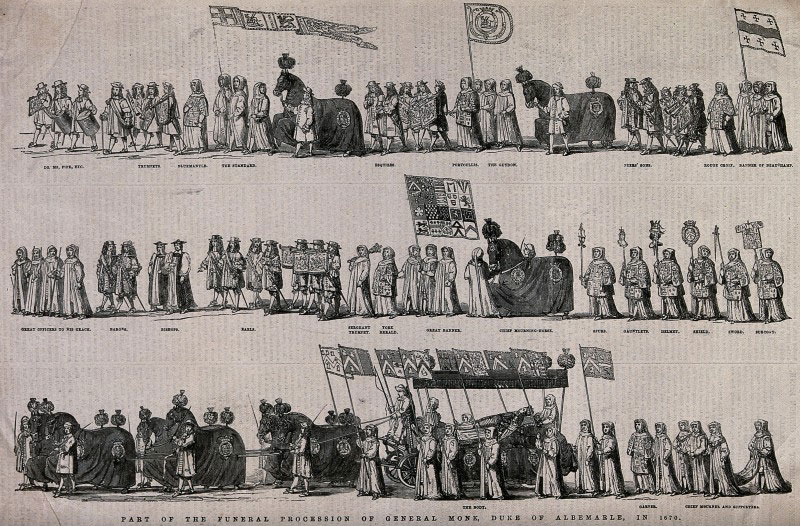
| Part of the funeral procession of General Monk, Duke of Albemarle, in 1670. Wood engraving.
1852© Wellcome Library, London |
![]() |
| Funeral procession of a queen passing through Hammersmith in London. Etching with engraving by C. Canton after R. Banks © Wellcome Library, London |
The two top photographs were taken of framed 'photo-collages' - for want of a better word - at Fiskars Museum. I've not really seen anything quite like it in the UK before. Perhaps it is a peculiarly Finnish way to document people linked by blood, institution, geography or politics? They reminded me of images that I've been collecting of visual lists for some time now, including this one by Hogarth and three funeral procession prints (all from the Wellcome Trust).
10.8.12
wood
It's hard not to develop a pretty honed tunnel vision for wood while you're here… It seems to crop up just about everywhere. From the architecture to the epic log piles, the book jackets to the kitchen utensils. Even the fact that tenant farmers labour here was once diligently recorded on pieces of wood to ensure the correct wages see penultimate image - taken by Perttu Rista and found in Fiskars 1649: 360 Years of Finnish Industrial History, published by Fiskars Oyj Abp, Raasepori 2009). It makes sense. It's practical. There's an abundance of the stuff in these parts. And it somehow creates a 'oneness' between the natural and the manufactured worlds. Makes for a sense of unity and calm.
See SB's blog for more lovely pictures of tools…
9.8.12
historical, scientific, artistic, cultural

Ah, the joys of local museums.
Fiskars Museum came up trumps the other day with modest and rather beautiful displays.
The way I like them best.
Subscribe to:
Posts (Atom)